Why peak conversion drops and why it’s not just the website

By Aimée Hart, Head of Experience Strategy
Fluctuations in CVR is often nothing to do with the website.
Every November, without fail, someone in a peak trading meeting says: “Conversion’s down. Something must be wrong with the website.”
Cue panic. Every team scrambles to fix its own corner, and the website gets prodded, tweaked, and patched in the one month it was meant to be left alone.
The tsunami of peak advice doing the rounds (AI-generated or otherwise) won’t spare you from hearing those words. It just hands you a new and improved checklist for 2026: compress your images, offer guest checkout, test your discount codes, and so on.
This isn’t another checklist.
Think of peak like a first date: your ad does the asking out; your landing page has to turn up as promised. Put all your effort into the ask, then send a stranger to the restaurant, and it’s not going to end well.
This article is about closing that gap: what conversion is really telling you, why the handover falls between teams, and how to make a first impression that lasts longer than three seconds.
Why conversion rate isn’t a website metric
Conversion rate is a ratio: orders on top, sessions underneath. Anything that moves either number moves the rate.
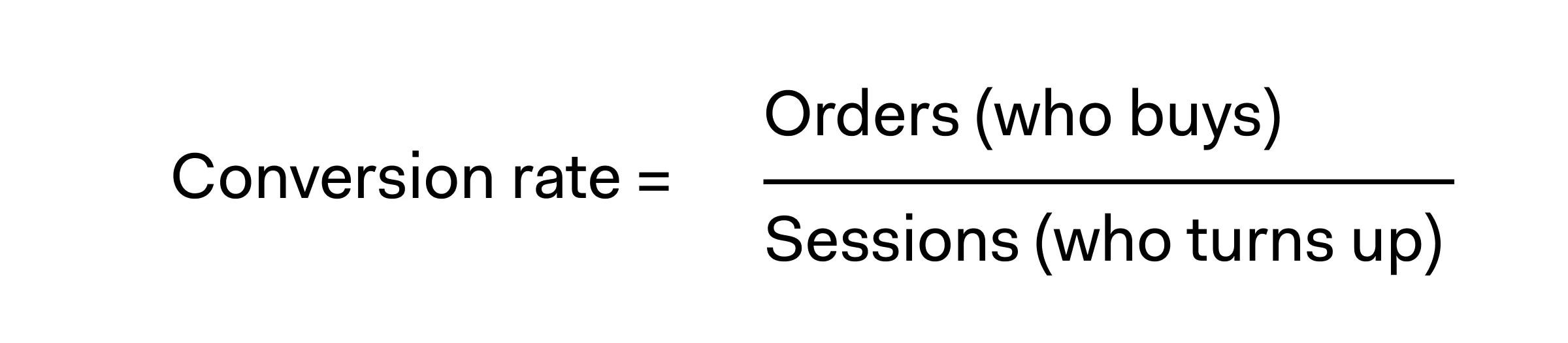
Our brains default to a simple story.
Paid media brings people to your door (pre-click). The website makes them buy (post-click). So, conversion rate must equal the website, and if it drops, something must be broken, right?
Not quite.
The top number is shaped by everything that affects whether someone buys: price, stock, delivery promises, competitor offers, payday, someone’s last-minute Secret Santa list, even the weather.
The bottom number is shaped by everything that brings people to your site, whether they’re ready to buy or not.
Peak distorts both.
Your traffic spikes with gift buyers, deal hunters, and lapsed customers who last visited a year ago. A dip in conversion on Black Friday might simply mean your marketing worked brilliantly at reaching people who just… browse.
Here’s how that plays out.
In the example below, total traffic stays the same, and every channel converts exactly as it did before peak. The only change is the mix: email traffic falls, and social picks up the difference.
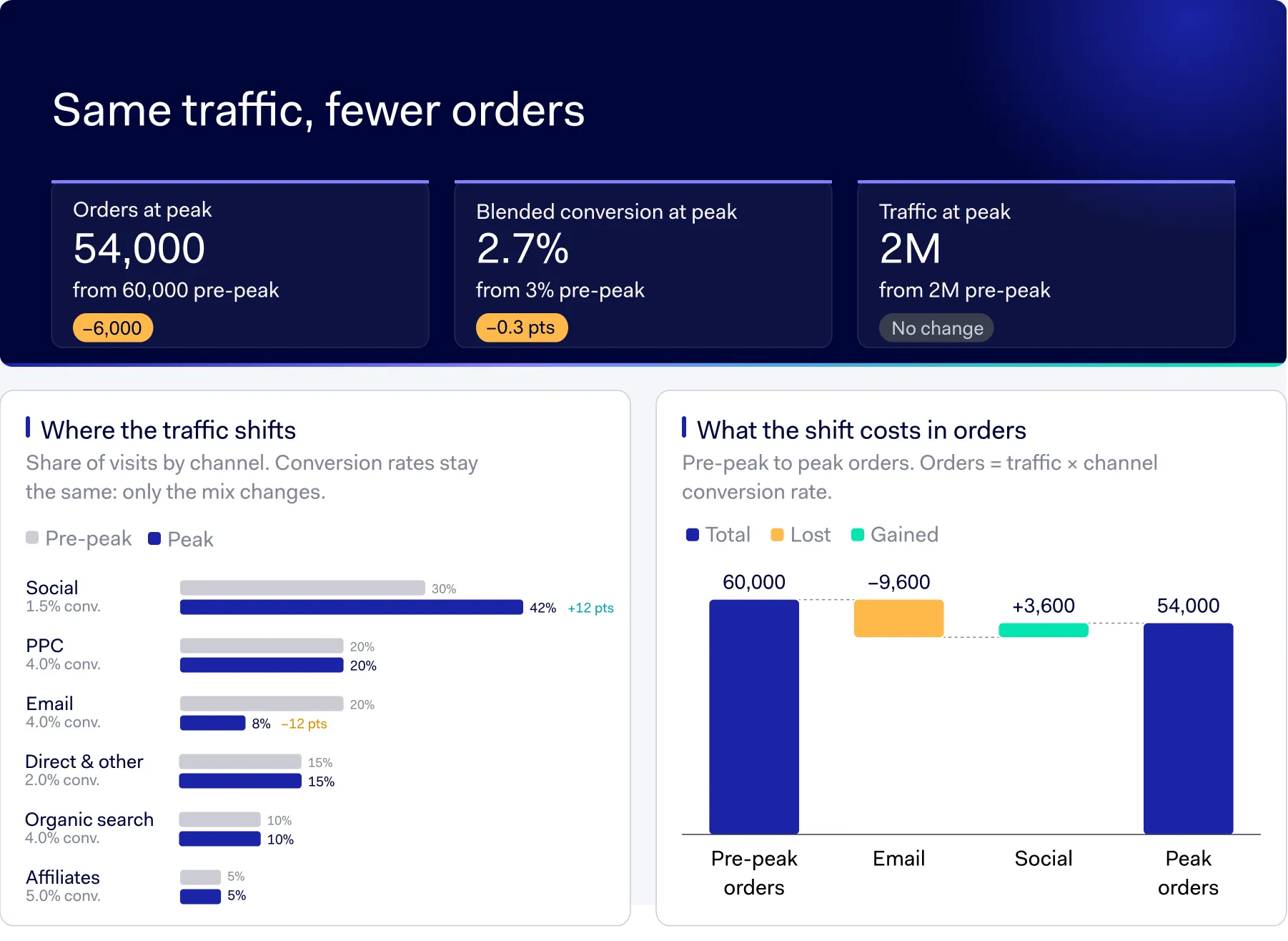
Same 2 million visits. No channel converts any worse. Yet conversion falls from 3.0% to 2.7%, and 6,000 orders disappear, because 240,000 visits moved from email (4.0%) to social (1.5%).
Senior stakeholders see orders drop, and the website takes the blame.
So, before anyone touches the site mid-peak, ask a better question: which traffic has changed, where did it come from, how would we expect that traffic to convert, and what was it promised before it arrived?
The handover that exposes your silos
Your paid ad makes one compelling promise, built to stop a thumb mid-scroll. Then it hands the visitor over to your site.
A product page needs to answer every question for every visitor. A landing page needs to answer one question for one visitor: “Is this what I clicked on?”
In most businesses, marketing owns the ad and ecommerce owns the site. So, nobody is minding the gap between them. A good campaign landing page closes it. Treat it as the second half of the ad: it carries the message forward and builds enough confidence to buy, not bounce.
Build peak landing pages on the first-date rule: 3-30-3
Back to that first date. They have three seconds to decide whether they like the look of you. Thirty to decide whether you’re worth a drink. Three minutes to decide whether there’s a second date. Each window serves a different visitor asking a different question.
3 seconds: “Am I in the right place?”
The first glance should confirm what the ad promised. At peak, that usually means one or two things: is the offer still live, is this the best value for money, and will it arrive in time?
30 seconds: “Does this solve my problem?”
Engaged visitors scan subheadings, short benefit lines, prices, and the call to action. Match the content to the audience the ad was targeting: a gift buyer, a deal hunter, and a loyal regular need different answers.
This is where most landing pages win or lose.
3 minutes: “Can I trust this?”
A smaller group keeps going: reviews, product detail, comparisons, size guides, the returns policy. These are your deliberators. Don’t give them a reason to call it a night.
Make landing pages easy to build, or they won’t get built
The usual objection lands about now: “We don’t have the dev time, and the site’s frozen.”
Fair. If every campaign page is a bespoke build, it won’t happen in November. You need flat-pack, not bespoke joinery.
That’s why the foundation matters more than the page.
When we worked with a multi-brand outdoor retailer on Shopify, we didn’t design each brand’s site from scratch. We built one design system: reusable components for the key shopping journeys, grounded in Baymard research, using Shopify’s own sections and terminology so designs moved cleanly from Figma into the theme.
The result was a toolkit of proven parts. Non-technical teams could put together a new page in minutes, inside the brand’s look and feel, without touching code.
For peak, that’s the difference. A campaign landing page stops being a development request and becomes a content task.
Marketing can build the page that matches their ad, the structure customers rely on stays intact, and nothing breaks the code freeze.
The bonus: a safe place to test
Landing pages are simpler than your main site, built for one intent, and separate from the templates you froze weeks ago. Because they’re built from components, testing two headlines is a content change, not a sprint.
That matters, because peak brings customers you don’t know well. What works for your regulars is only a guess for a first-time gift buyer.
So test it: headlines, offer framing, where the reviews sit. A winning message in November becomes a hypothesis for your category pages in January.
What to do in the six weeks before Black Friday
Black Friday falls on 27 November this year. That leaves time to work in the magic:
1. Map every peak campaign to the page it lands on. Any ad pointing at a generic category or the homepage is a handover gap.
2. Build each landing page from existing components and match the top to its ad: same headline, same image, same offer.
3. Structure each page on 3-30-3: the promise first, the scannable answers next, the depth last.
4. Pick two or three things to test on your busiest landing pages and agree what success looks like before launch.
5. Report conversion by traffic source and by landing page, not as one blended number, so the trading meeting debates the right thing.
Keep the operational basics in hand too. Our CommerceOps team covers these in Expert tips for a successful peak season strategy.
Diagnose the traffic before blaming the site
Blaming the website for a dip in peak conversion is like blaming the kids when they won’t eat their Christmas dinner. The food’s fine, delicious in fact. They’ve just been at their stocking sweets since 6am and you didn’t have time to notice.
So this November, when someone in the trading meeting says, “conversion’s down, something must be wrong with the website,” you’ll have better questions ready to triangulate the data and a solid response: Which traffic? From which ad? Landing where?
Peak won’t be won by the team that blames the website first. It’ll be won by the team that remembers what its ads promised, and keeps that promise from the first click to the checkout.
Tryzens’ customer experience team works with major brands and global retailers on evidence-led UX. Talk to us about your peak plans.